As organisations and communities tackle increasingly complex challenges; from improving public health to promoting sustainable behaviours, effective behaviour change has become essential.
Yet many interventions still fall short because they are designed for people rather than with them.
This is where co-creation and co-design make a transformative difference. At HBCL, we now incorporate co-creation and co-design into nearly all of our behaviour change projects to ensure solutions are relevant, inclusive, and sustainable.
What Are Co-Creation and Co-Design?
Co-creation and co-design are collaborative approaches that actively involve the people affected by a challenge in developing solutions.
- Co-creation involves working alongside individuals and communities to generate ideas, insights, and understanding based on their lived experience.
- Co-design goes a step further by involving them in designing, testing, and refining solutions. In practice, the two often overlap.
These approaches shift people from being passive recipients of interventions to active partners, ensuring behaviour change strategies are grounded in real-world needs.
Why Co-Creation Matters for Behaviour Change
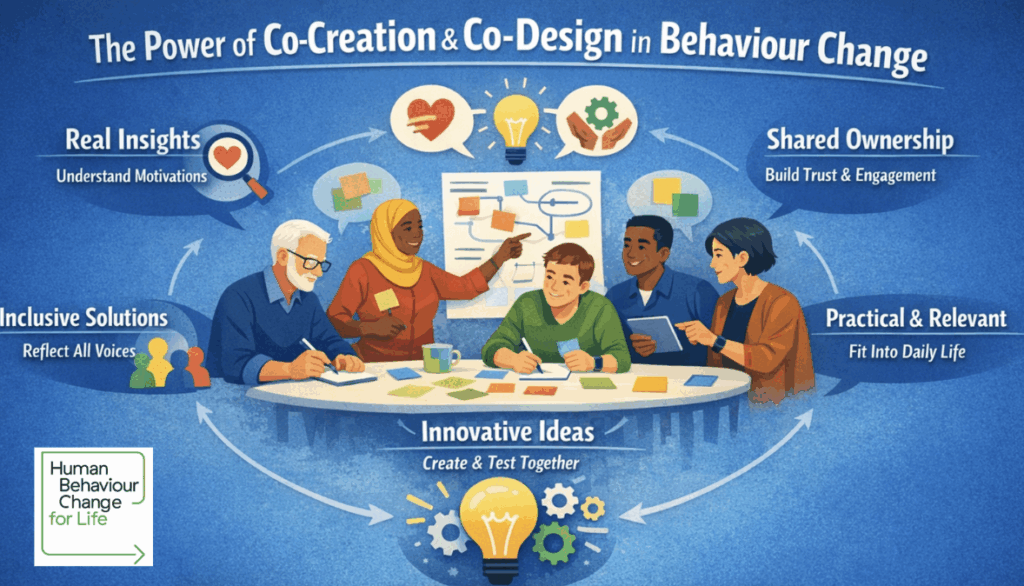
1. Uncovers Real Motivations
Human behaviour is not driven by logic alone. It is shaped by emotions, habits, social norms, and context. Co-creation helps uncover these deeper drivers, enabling behaviour change interventions that reflect what truly matters to people—not assumptions made from the outside.
2. Builds Ownership and Trust
When people are involved in shaping solutions, they feel invested in them. Co-design builds ownership, increases trust, and improves long-term engagement. Instead of being told what to change, individuals help define how change happens.
3. Fits Into Real Lives
Effective behaviour change must be practical. Co-design ensures interventions align with everyday realities such as time pressures, cultural norms, social dynamics, and environmental constraints. This makes desired behaviours easier to adopt and sustain over time.
4. Supports Inclusivity and Equity
Different groups have different needs. Co-creation brings diverse voices into the design process, ensuring interventions reflect variations in culture, identity, ability, and lived experience. Inclusive design increases both reach and impact.
5. Drives Innovation
By combining lived experience with the expertise of designers, practitioners, and behavioural scientists, co-creation sparks innovation. Solutions developed from multiple perspectives are often more creative, feasible, and resilient.
How Co-Design Strengthens Behaviour Change Interventions
Co-design encourages rapid prototyping and early testing of tools, messages, or systems to understand what resonates and why. This allows teams to quickly identify what works, what doesn’t, and how to improve outcomes.
It also helps build a community of advocates who are more likely to share and champion the intervention within their networks—amplifying impact and accelerating change.
How is Behaviour Change Most Effective?
Behaviour change is most effective when people feel understood, respected, and included. Co-creation and co-design make this possible by embedding real experiences and real voices into every stage of the process.
By designing with people rather than for them, organisations can create behaviour change solutions that are not only effective, but sustainable, meaningful, and truly human-centred.
Want to Learn More?
If you’d like to explore how co-creation and co-design could strengthen your behaviour change work, get in touch with us at info@hbcforlife.org.
